
Amid rising political instability and a volatile global landscape, businesses face unprecedented uncertainty. Shifting markets and rapid change make decision-making increasingly complex, threatening even the most resilient organisations.
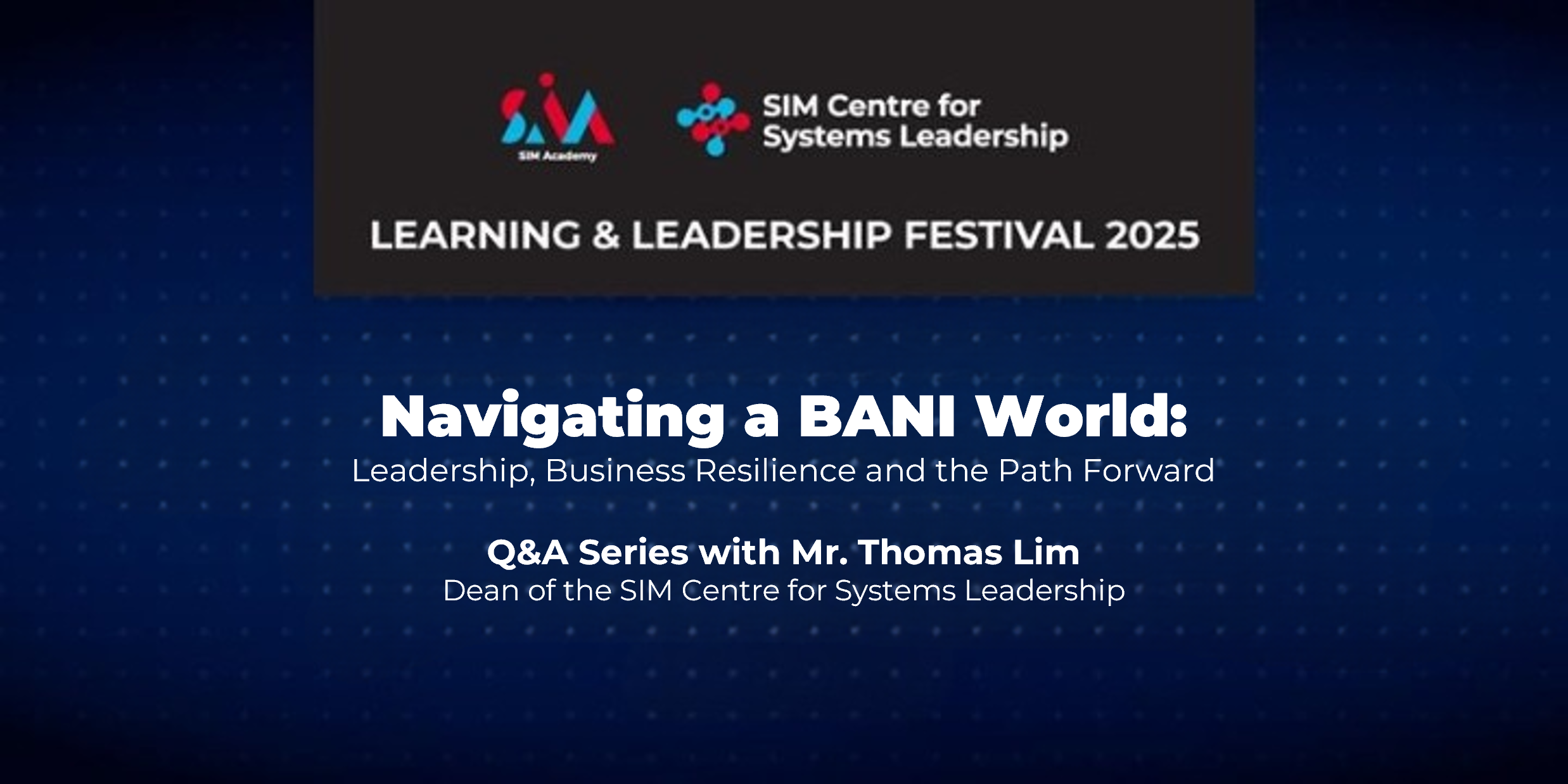
We sat down with Thomas Lim, the Dean of the SIM Centre for Systems Leadership, to answer burning question raised at the recent SIM Learning & Leadership Festival 2025.
Q: How does systems thinking and the consideration of wicked problems by multiple lenses fit into a world of AI. Can AI be a force multiplier here?
Thomas: AI can accelerate systems insight through pattern detection, scenario testing, and decision support, but human judgment remains central. We are still in an early stage with respect to this development. The future belongs not to AI alone, but to organisations where human judgment, values, and ethical leadership guide intelligent systems.
Q: How will AI affect system leadership or system thinking?
Thomas: AI shifts leadership from knowing to sensemaking i.e. curating meaning, ethics, and coherence across interconnected decisions. With AI, more robust and trustworthy scenario planning can arise when used in conjunction with theories of change.
Trust emerges when organisations make long-term commitments, invite scrutiny, and invest in capabilities that genuinely transform how they operate, serve society, and protect the future.
Q: In an era where every company claims to be “green” and “AI-driven”, how can leaders prove authenticity and avoid falling into greenwashing or AI-washing?
Thomas: Anchor claims in transparent metrics, third‑party validation, lived practice, and clear outcomes tied to purpose, and not slogans. The real test is providing substantive evidence for the claims.
Q: What are the potential risks/ opportunities associated with non-human identities (e.g. AI agents) conducting transactions in consumer banking, and how might this impact the banking sector within the context of BANI?
Thomas: Opportunities: efficiency, inclusion, new service models.
Risks: trust, ethics, and systemic fragility. Strong governance and adaptive safeguards needed.
Q: How do we see the people, private and public sector working more closely together in this fragmented world to ensure that our nation is better insulated from global volatility?
Thomas: The ecosystem players can come together to build shared missions, trusted data flows, and learning coalitions. Align incentives and governance with public good.
Q: What future perspectives should the government consider in future development?
Thomas: Think regenerative economy, demographic shifts, planetary constraints, and digital governance. We could work towards designing for resilience and social trust.
Q: How should leadership development evolve to help future leaders operate effectively in unpredictable, interconnected contexts?
Thomas: Develop leaders who sense patterns, convene dialogue, steward purpose, and learn in real time, and iterate – not just execute plans in a linear fashion.
Q: Should Systems Thinking and Systems Leadership be formally brought into the national curriculum/ education system at an earlier age for the next generation in SG to be prepared for the BANI/ VUCA present and future?
Thomas: That is an interesting and perhaps useful suggestion. Starting early with perspective‑taking, causal reasoning, and reflective practice through real‑world problem‑solving.
Q: How do you think SIM as one of the leading private organizations in the education industry can evolve? Specifically with lesser companies willing to invest in their people in terms of upscaling and even dismissal of manpower due to budget constraint?
Thomas: SIM has evolved our capability development agenda, and we attempt to host and facilitate more systemic ecosystem-wide conversations. To achieve this, we need to look into shifting to capability partnerships, modularized applied-learning, and AI‑enabled personalised development pathways.
As organisations look for value and impact, SIM’s role strengthens as a trusted capability partner — not merely a provider of programmes, but an enabler of strategic transformation.
This is part 3 of this 3-part series on the SIM Learning & Leadership Festival. Contact us at simacademy@sim.edu.sg for your organisational training needs on Systems Leadership.